Figure 1. The river at dawn. A ferryman poles a traveller across, as Vasudeva once carried Siddhartha. Every illustration in this article is an original watercolour sketch made in the spirit of Hesse’s own paintings.
Preface
Siddhartha is a short book that reads quickly and understands slowly. This article is for the slow part. It starts with Hermann Hesse and the Europe he lived in, then travels back to ancient India, where the story is set. The middle is the chapter guide. The last part steps back to look at the people, ideas and images of the whole book, and at how readers around the world have taken it.
On names. Most names in the book come from Sanskrit or Pali, the old languages of Indian religion, and several of them carry meanings. The glossary at the end gives the main names and terms in German, English and Chinese, as a bridge to Chinese editions.
I. The Book in Brief
Siddhartha is a short novel about one man’s whole life, told as a search for inner peace. Hesse published it in German in 1922 under the subtitle Eine indische Dichtung, “An Indian Poem”. It has twelve chapters in two parts and runs to fewer than 200 pages in most editions.
The whole story
Siddhartha is the gifted son of a Brahmin, a priest of the highest caste, in India in the lifetime of the Buddha. Everyone admires him. He is unhappy anyway, because the prayers and holy books of his father have not given him peace.
He leaves home with his friend Govinda to live as a Samana, a wandering ascetic. For three years he fasts, meditates and trains himself to feel nothing. He learns to escape from himself for a while. He never learns to find himself.
The two friends go to hear Gotama, the Buddha. Govinda joins the Buddha’s monks. Siddhartha honours the Buddha, yet he decides that no teacher can hand him what the Buddha found, and he walks on alone.
He crosses a river into the world of the senses. The courtesan Kamala teaches him love, and the merchant Kamaswami teaches him business. Over many years he grows rich, and slowly he turns into the kind of person he once looked down on: restless, greedy, a gambler. One night he walks away from all of it.
At the same river, disgusted with himself, he leans over the water to drown. The sacred syllable Om rises from somewhere deep inside him and stops him. He stays by the river with Vasudeva, the old ferryman, who teaches him to listen to the water.
Years later Kamala comes to the river with a boy, Siddhartha’s son, whom he has never met. She dies there of a snakebite. Siddhartha loves the boy with his whole heart, and the boy runs away from him. Through this wound Siddhartha finally hears what the river has been saying: all of life is one, and nothing is ever truly lost. Vasudeva leaves for the forest, and Siddhartha becomes the ferryman.
In the last chapter Govinda, now an old monk, comes to the river and does not recognise his friend. Siddhartha tells him that wisdom cannot be taught. Then he asks Govinda to kiss his forehead, and in that moment Govinda sees what no words could have told him.
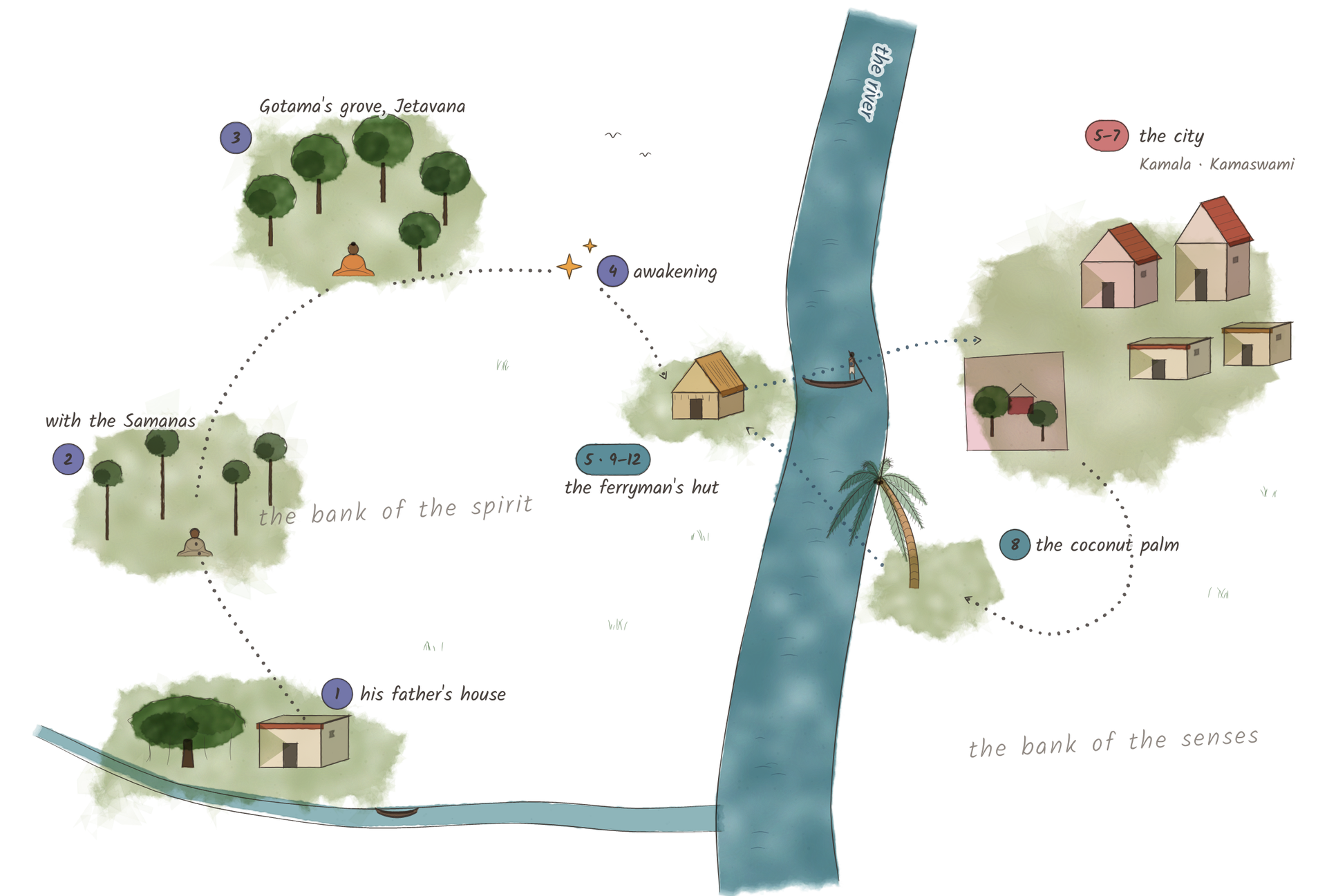
Figure 2. Siddhartha’s journey as a map. The numbers are chapters. The novel gives no real geography, so the map shows only the order of places and his two crossings. The bank names follow the reading of the river in the section on symbols.
Where difficulty lies
The plot is simple. Readers get stuck in four other places.
- The ideas. They come from Hindu, Buddhist and Chinese thought and arrive without explanation. The section “Three Streams of Thought” explains them.
- The voice. Hesse writes long, rhythmic sentences full of repetition, closer to a sacred text than to a modern novel. Reading slowly, or aloud, helps a great deal.
- The ending. The last lessons come as paradoxes: time is not real, the opposite of every truth is also true, wisdom cannot be taught. They are meant to be lived with more than proven. The section “Difficult Passages” takes them one at a time.
- The author. Hesse wrote the book during the worst crisis of his life, and parts of it are a private confession in Indian dress. Knowing his story makes many scenes clearer.
II. Hermann Hesse
Hermann Hesse (1877-1962) was a German-born writer who became Swiss, won the Nobel Prize in Literature in 1946, and spent his life writing about people who break away to find themselves. He once called his novels “biographies of the soul”. Siddhartha is one of them, and the soul is largely his own.
India at home
Hesse was born on 2 July 1877 in Calw, a small town in the Black Forest in southern Germany. His family were Pietists, devout Protestants who prized inner faith and strict discipline.
The family was full of India. His grandfather, Hermann Gundert, had worked for decades as a missionary in Kerala in South India and compiled a Malayalam grammar and dictionary. His mother, Marie, was born in India in 1842, and his father, Johannes, a Baltic German from Estonia, had served there briefly as a missionary too.
The boy grew up among Indian objects and his grandfather’s library of world literature. Looking back, Hesse wrote that the Indian world felt roomier to him than the narrow piety of home, and that its first messages stayed with him all his life.
Off the set path
His parents meant him to become a pastor. In 1891 he entered the Protestant seminary at Maulbronn Abbey. Within months he was in crisis: he ran away in March 1892 and attempted suicide that May.
After a string of institutions and schools, he left formal education behind. He worked in a clock-tower factory, then in October 1895 began an apprenticeship in a Tübingen bookshop. In the evenings he read Goethe, the German Romantic poets and Nietzsche.
In 1899 he moved to a bookshop in Basel. His later novel Beneath the Wheel (1906) retells the seminary years.
Success and marriage
The novel Peter Camenzind (1904) made him a professional writer. That year he married Maria Bernoulli and moved to Gaienhofen, a village on Lake Constance, where they had three sons.
In these years, rereading the philosopher Schopenhauer and dipping into Theosophy, a popular blend of Eastern and Western mysticism, brought India back into his thoughts. In 1912 the family moved to Bern, in Switzerland.
The voyage of 1911
In September 1911 he sailed for Asia with his friend, the painter Hans Sturzenegger. They visited Ceylon (now Sri Lanka), Penang, Singapore and Sumatra.
The journey disappointed him. He was ill for much of it, the heat and noise oppressed him, and he turned for home without reaching the Indian mainland. What he kept from it, he wrote in 1917, was one plain conviction: humanity is one, across every border.
Breakdown and analysis
When the First World War began in 1914, Hesse volunteered, was found unfit, and worked for the welfare of German prisoners of war. In November 1914 he published an essay begging writers not to join the chorus of hatred. Its title, “O Friends, Not These Tones”, borrows the first words sung in Beethoven’s Ninth Symphony.
The German press called him a traitor, and hate mail followed for years. The French writer Romain Rolland, also a pacifist, visited him in 1915 and stayed his friend until Rolland’s death.
In 1916 his father died, his youngest son fell gravely ill, and his wife’s mental illness worsened. Hesse broke down and went into therapy with Josef Bernhard Lang, a student of the psychologist Carl Jung. Out of this came the novel Demian (1919), published under the false name Emil Sinclair, and a new habit: painting.
Montagnola
By 1919 his marriage had collapsed and his sons were living with others. In May 1919 he moved alone to Montagnola, a village above Lake Lugano in Italian-speaking Switzerland, and rented four small rooms in an old house, the Casa Camuzzi.
He was poor and often lonely, yet he later called that first year the fullest and most productive of his life. He painted bright watercolours of the hills, wrote the novella Klingsor’s Last Summer (1920), and began Siddhartha. He lived in Montagnola for the rest of his life.
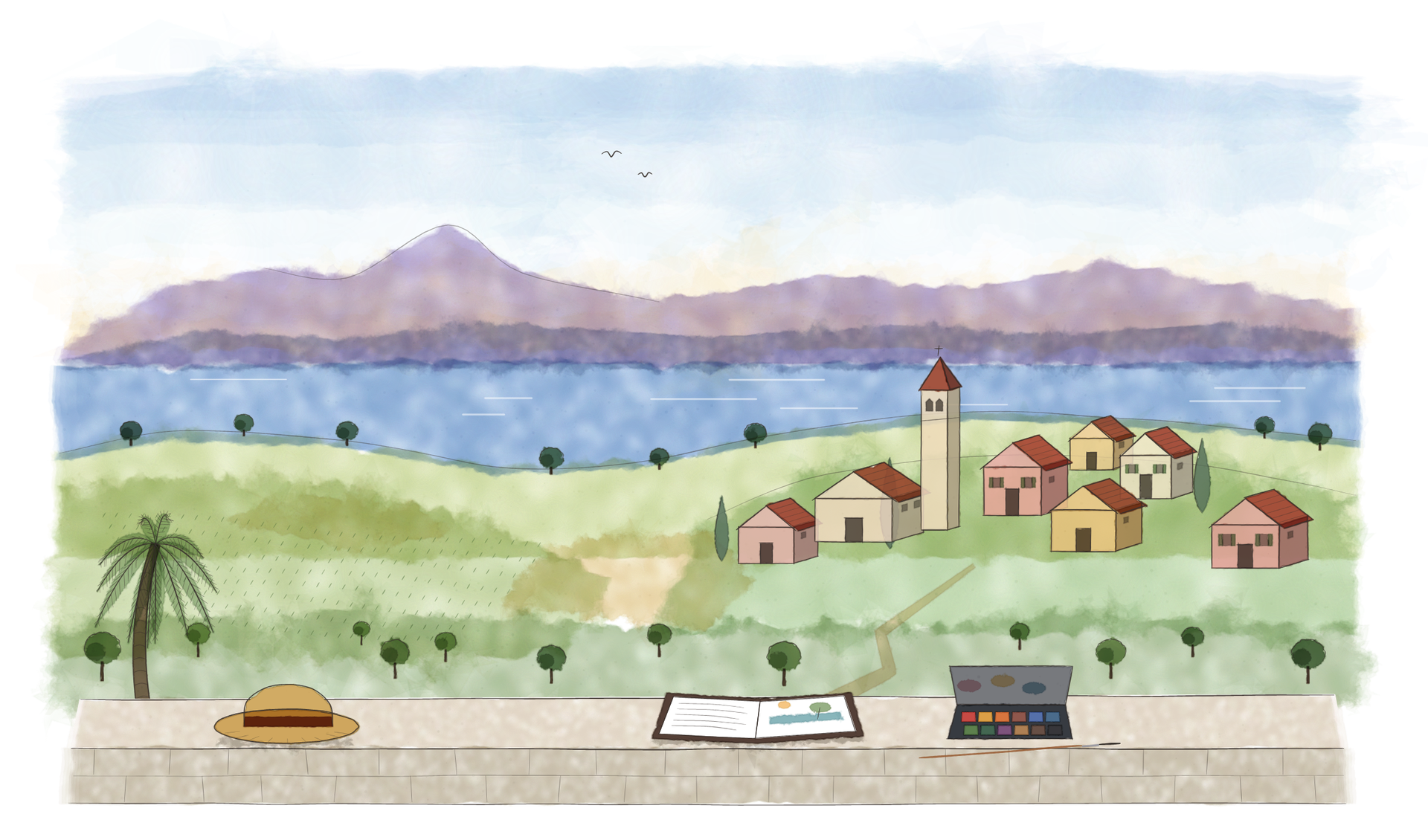
Figure 3. A Ticino morning. A straw hat, a sketchbook and a paintbox rest on a wall above the lake. The scene is an original sketch in the manner of Hesse’s Montagnola watercolours, not a copy of any of his paintings.
Late fame
Hesse became a Swiss citizen in 1923. A brief second marriage, to the singer Ruth Wenger, lasted from 1924 to 1927. In 1931 he married the art historian Ninon Dolbin, and a patron built them a house in Montagnola.
The major novels followed. In 1933 he helped Thomas Mann and Bertolt Brecht on their way into exile from Nazi Germany. He received the Nobel Prize in 1946 and died in Montagnola on 9 August 1962, aged 85. His worldwide fame, as the section on reception explains, arrived only in the decade after.
Year | Novel | In one line |
1904 | Peter Camenzind | A mountain village boy goes into the world, becomes a writer, and comes home |
1906 | Beneath the Wheel | A gifted pupil is crushed by school and ambition |
1919 | Demian | A young man breaks from conventional morality toward his own self |
1922 | Siddhartha | A Brahmin's son finds peace through his own experience, by a river |
1927 | Steppenwolf | A lonely intellectual is torn between the man and the wolf in him |
1930 | Narcissus and Goldmund | A monk-scholar and a wandering artist take opposite paths to the same truth |
1932 | Journey to the East | A secret league's pilgrimage, told by a member who lost his way |
1943 | The Glass Bead Game | A future order of scholars, and the master who walks out of it |
III. Writing Siddhartha
Hesse wrote Part One of Siddhartha in a few months, then could not go on for about eighteen months, because he had not yet lived what came next. The finished book is, in a real sense, the record of how he got unstuck.
An easy start
He began in December 1919, in his rented rooms in Montagnola, and had finished the four chapters of Part One by the summer of 1920. Those chapters are about searching: the restless son, the starving ascetic, the young man who walks away from the Buddha. Hesse knew all of that from the inside.
His own life at the time looked a lot like his hero’s. His biographer Ralph Freedman pictured him as a kind of Samana in twentieth-century Switzerland: poor, living on rice, milk and macaroni, walking the hills in worn clothes. A few years later Hesse told Romain Rolland that in his heart he was a Samana who belonged in the forest.
The long pause
By mid-1920 he was writing to friends that his Indian “poem” lay fallow. He explained why with unusual honesty: to continue, he would have to describe a stage of inner growth that he had not yet reached himself.
The problem was built into the story. Part One describes a man looking for peace. Part Two had to describe a man who finds it, and Hesse, depressed and divided, could not fake that. In July 1921 Part One appeared in print on its own, a story with no ending.
Jung, the sutras and the Tao
In May and June 1921 Hesse had sessions of analysis with Carl Jung himself, at Küsnacht near Zurich. He wrote that the therapy helped him make a quiet space inside, where a deeper voice could be heard.
He went back to his reading too. In his diary he praised the Buddha’s discourses as a source of rare richness and depth. Yet in a 1921 letter he also said he was no longer a Buddhist: he found the doctrine beautiful but one-sided, and felt drawn instead to the India of gods and temples.
The last push came from China. In February 1922 he wrote that the novel had set out from Brahman and the Buddha and would end in the Tao, the Chinese “Way”. He took up the manuscript again in March, finished the eight chapters of Part Two in May, and the book came out in Berlin in October 1922.
Two dedications
Part One is dedicated to Romain Rolland, “my revered friend”. Rolland was the French novelist and pacifist who had stood by Hesse during the war and who wrote about Indian thought.
Part Two is dedicated to Wilhelm Gundert, “my cousin in Japan”, a scholar of East Asian religion and language. The split dedication is a small trace of the long pause: the two halves were written, in a sense, by two different men.
Hesse’s own verdict
Hesse never claimed to have written a book about the real India. He admitted that Siddhartha was a European book in Indian dress, and he called it a confession. In a 1931 essay titled “My Belief” he said that he had once tried to set down his faith in a book, and that the book was Siddhartha.
Looking back in 1958, he described it as the confession of a man raised as a Christian who left the church early to learn to understand other religions, above all those of India and China. He also said it gathered up what he had absorbed from Indian and Chinese traditions over twenty years.
One early reader pleased him greatly. In 1922 he met Kalidas Nag, a scholar from Calcutta, at a conference in Lugano and told him Siddhartha’s story. Nag praised it and urged that it be translated into every European language.
IV. Europe Looks East
Siddhartha appeared in a Europe that had lost faith in its own certainties. It also grew out of a German culture that had been looking to India for wisdom for more than a hundred years.
A continent in doubt
The First World War ended in November 1918 with Germany defeated, its emperor gone and its people hungry. The old pillars of meaning, the nation, the church and the faith in progress, looked badly cracked.
Educated Germans were reading Oswald Spengler’s The Decline of the West. Its first volume appeared in the summer of 1918 and its second in 1922, and by 1926 some 100,000 copies had sold. Spengler’s word for the West, Abendland, literally means “evening land”: he believed European culture was entering its twilight.
Hesse shared some of that mood, though not Spengler’s politics. In 1920 he wrote that half of Europe was already on the road to chaos, singing as it drove along the edge of an abyss. He wrote that he had long been convinced the European spirit was in decline and needed to return to its Asian sources.
Two books of 1922
The poet T. S. Eliot quoted that very passage from Hesse in the notes to The Waste Land, published in the autumn of 1922. Eliot’s poem names a section after the Buddha’s Fire Sermon, borrows three words from an Upanishad, and ends with the Sanskrit shantih, “peace”.
Siddhartha came out in October of the same year. One is a broken modernist poem and the other a calm legend, but both reach toward India for something Europe seemed to have lost.
A German dream of India
The dream began with the Romantic movement. In 1808 Friedrich Schlegel published On the Language and Wisdom of the Indians, which launched the serious study of Sanskrit in Germany and the comparison of Indian and European languages.
The philosopher Arthur Schopenhauer read the Upanishads in a Latin translation published in 1801-02. He called that book the consolation of his life, and said it would be the consolation of his death. Through Schopenhauer, Indian ideas reached generations of German readers, Hesse among them.
Later in the century scholars translated the scriptures directly. Paul Deussen put sixty Upanishads into German, Hermann Oldenberg wrote an influential study of the Buddha, and Karl Eugen Neumann translated the Buddha’s discourses from Pali. Hesse knew all three, and in 1912 he reviewed Neumann’s discourses and a new German Bhagavad Gita.
Theosophy spread Eastern ideas in a looser, more mystical form. Writers began to travel: between 1904 and 1913 Waldemar Bonsels, Max Dauthendey, Stefan Zweig and others went to India and wrote about it.
An India of the mind
The India these Germans loved was mostly ancient, spiritual and timeless. It came from books more than from travel. Hesse set his story in an unnamed past and drew it from scripture, family memory and his own inner life, not from the country he had failed to reach in 1911.
That is part of the book’s charm and part of its problem. The section on reception comes back to the criticism it invites.
V. India in the Buddha’s Time
The novel is set in northern India during the lifetime of the Buddha, some two and a half thousand years ago. Hesse keeps the background vague on purpose, but a few facts about that world make many scenes easier to follow.
Brahmins
Siddhartha is born a Brahmin, a member of the priestly class at the top of Indian society. Brahmins kept the Vedas, the oldest sacred hymns, and performed the sacrifices and daily washing rites of the first chapter.
After the Vedas came the Upanishads, philosophical dialogues that turn from ritual to one question: what is the self? Siddhartha knows them by heart. In Chapter 1 he repeats a line from the Chandogya Upanishad and murmurs a verse from the Mundaka Upanishad: Om is the bow, the self is the arrow, Brahman is the target.
His trouble is not ignorance. He knows the teachings perfectly and still has no peace, because no one around him lives what they recite.
Samanas
Samana is the Pali form of the Sanskrit śramaṇa, “one who strives”. In the Buddha’s time many such ascetics left home and family, wandered, begged for food, and practised fasting and meditation in search of liberation. Many rejected the authority of the Brahmins, and both Jainism and Buddhism grew out of this movement.
Hesse’s Samanas are a blend of these groups. Siddhartha spends about three years with them and learns to fast, to slow his breath almost to nothing, and to send his mind into a heron or a dead jackal. The historical Buddha also tried harsh self-denial for years before he rejected it.
Gotama
Gotama is the Pali form of Gautama, the family name of the man who became the Buddha, “the awakened one”. He was born a prince of the Shakya clan, which is why the novel also calls him Sakyamuni, “sage of the Shakyas”. His personal name was Siddhartha. Hesse gives that name to his hero, and the choice is deliberate.
The meeting in Chapter 3 takes place in the Jetavana grove near Savathi (also spelled Savatthi or Shravasti), capital of the kingdom of Kosala. Buddhist tradition says the merchant Anathapindika bought the grove from Prince Jeta by covering the ground with gold coins. The Buddha spent nineteen rainy seasons there, more than anywhere else, and many of his discourses open at “Savatthi, in Jeta’s Grove”.
Hesse names the town, the grove and its donor just as the old texts do. He mostly uses Pali spellings, the forms of the early Buddhist scriptures he read in German translation.
Kamala’s garden
Late in the novel Kamala gives her pleasure garden to the Buddha’s monks and becomes one of his followers. Readers who know the Buddhist texts will hear an echo of Ambapali, a famous courtesan of the city of Vesali. On the Buddha’s last journey, shortly before his death, she gave his order her mango grove, and she later became a nun.
Rivers and crossings
The plain of northern India is river country, and Buddhist language is full of crossings. Liberation is pictured as reaching “the far shore” from the shore of suffering. The Buddha compared his own teaching to a raft: made for crossing over, not for carrying around once the far shore is reached.
Hesse’s ferryman does something stranger. He crosses back and forth all his life, and the wisdom turns out to lie in the river itself. The section on symbols comes back to this.
What Hesse invented
Apart from Gotama and the places tied to him, nearly everything in the novel is imagined. Govinda, Kamala, Kamaswami and Vasudeva are fictional. Siddhartha’s home town, the big city and the river are never named, and the river is never identified as the Ganges.
VI. Three Streams of Thought
Hesse built Siddhartha’s search out of three traditions, and he said so himself: the book sets out from Brahman and the Buddha and ends in the Tao. A fourth, quieter stream, the Christianity of his childhood, surfaces at the end as love. None of them needs to be mastered first. A dozen ideas are enough to follow the book.
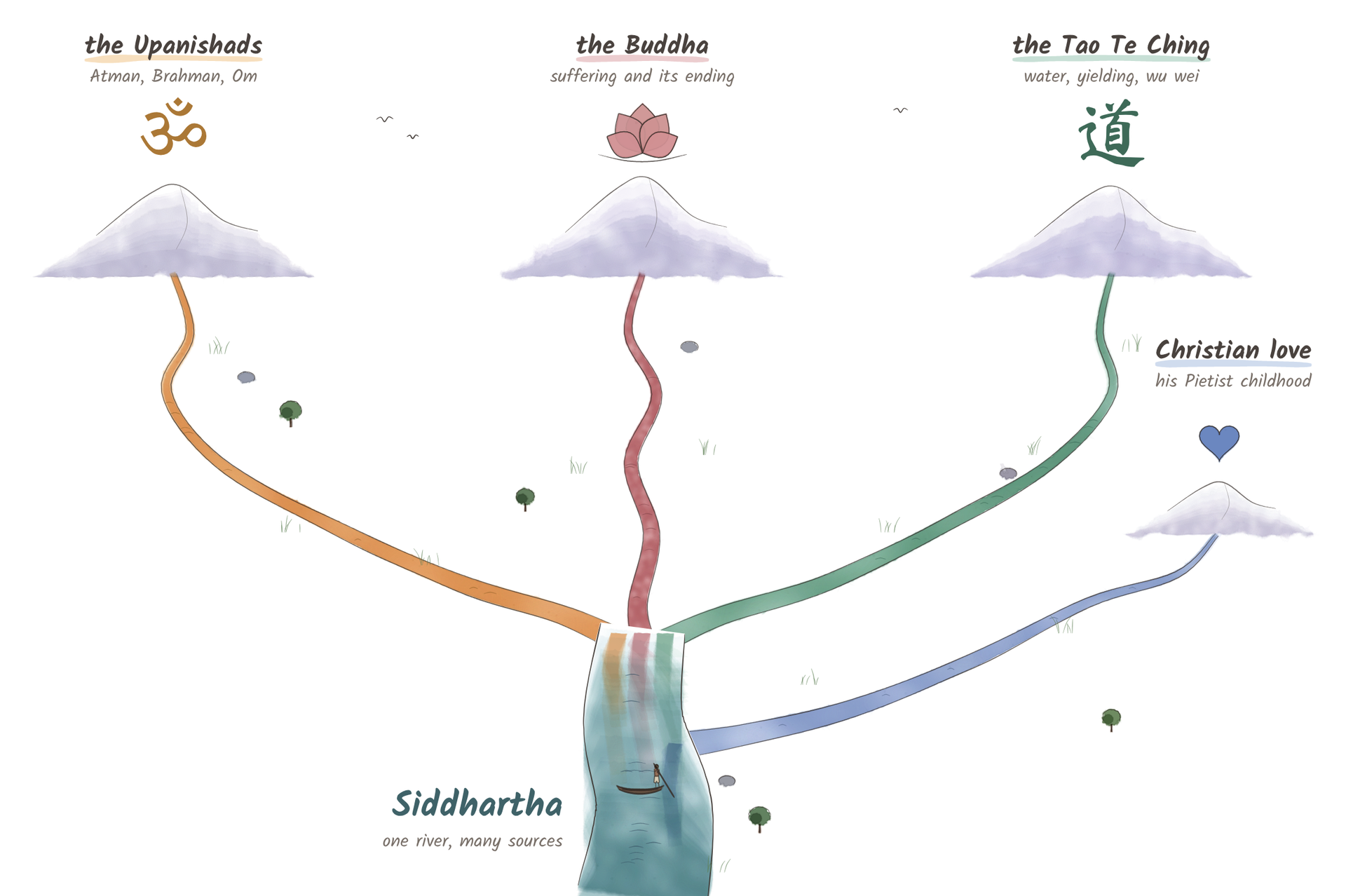
Figure 4. One river, many sources. Three main streams feed the novel: the Upanishads, the Buddha and the Tao Te Ching. A smaller stream, the Christian love of Hesse’s childhood home, joins late, as it does in the book’s last pages.
The Hindu stream
The Upanishads ask what lies at the bottom of a person. Their answer has two names. Brahman is the one reality behind everything. Atman is the true self deep inside each person. The great claim of the Upanishads is that the two are the same, summed up in the phrase tat tvam asi, “that art thou”.
Siddhartha’s first question is practical: if Atman is inside me, where exactly is it, and why has no one I know actually found it?
Om is the sacred syllable spoken at the start and end of prayers, and the Mandukya Upanishad treats it as standing for everything that is. It saves Siddhartha at the river, and at the end it is the single word he hears inside the river’s thousand voices.
Samsara (Hesse writes Sansara) is the wheel of birth, death and rebirth, and by extension the endless round of ordinary craving. Chapter 7 takes its name from it. Maya is illusion, the veil of appearances that the wise are supposed to see through.
Two names in the book point to the Bhagavad Gita, which Hesse knew well. Vasudeva and Govinda are both names of Krishna, the god who teaches the warrior Arjuna in that poem.
The Buddhist stream
In Chapter 3 the Buddha preaches his core teaching, the Four Noble Truths: life is marked by suffering; suffering comes from craving; it can end; and a path leads to its end. That path is the Eightfold Path of right view, intention, speech, action, livelihood, effort, mindfulness and concentration.
The Buddha called his way the Middle Way, between self-indulgence and self-torment. Siddhartha lives both extremes in turn, the starving Samana and the rich gambler, before he finds his own middle by the river.
What Siddhartha most admires is the Buddha’s picture of the world as an unbroken chain of causes. What troubles him is nirvana, the “blowing out” of craving, which seems to break that chain by promising a way out of the world.
One doctrine Hesse quietly leaves aside. The Buddha taught anatta, that there is no permanent self, while Hesse’s hero, still a Brahmin at heart, keeps looking for one. Here the novel’s Buddhism is Hesse’s own.
One small phrase shows how closely Hesse read the old texts. In the Pali discourses, the Buddha calls speculative opinions “a thicket of views”, in a dialogue set at Jeta’s Grove. Hesse’s Gotama warns young Siddhartha against the thicket of opinions, and old Siddhartha uses the same phrase in the last chapter.
The Taoist stream
The Tao Te Ching, attributed to Laozi, describes the Tao, the Way: the natural flow of things, which no words can pin down. Hesse read it in German translations, Richard Wilhelm’s among them, and it was his father who first pointed him to Laozi.
The Tao’s favourite image is water. The highest goodness, says the book, is like water: it helps all things without competing and settles in the low places people avoid. Nothing is softer than water, yet nothing is better at wearing down what is hard.
Hesse gives these lines to Vasudeva almost word for word. The river, he tells Siddhartha, has taught him that it is good to strive downward, to sink, to seek the depths. Later he says that soft is stronger than hard, water stronger than rock, love stronger than force.
Taoism also prizes acting without forcing, called wu wei, and the unity of opposites, the idea behind yin and yang. Both shape the last chapter. “Seeking means having a goal,” Siddhartha tells Govinda. “Finding means being free.” And he adds that the opposite of every truth is just as true.
A Christian undercurrent
Hesse said that his parents’ Christianity, lived rather than preached, was the strongest force in his upbringing. In 1923 he named the New Testament beside the Upanishads, the Buddha, Confucius and Laozi as the places where he had found the deepest truth.
It shows at the end. Siddhartha calls love the most important thing in the world, and Govinda objects that the Buddha taught kindness and patience, not love. Many readers hear the Gospel in Siddhartha’s answer.
Borrowing and bending
Siddhartha is not a textbook of any religion. Hesse takes from each tradition what serves one man’s path: the Upanishads’ unity of self and world, the Buddha’s trust in experience, the Tao’s water and non-striving, and Christian love. Then he lets them argue inside the story.
Idea | Tradition | Where it shows up in the novel |
Atman and Brahman are one | Hindu (Upanishads) | Siddhartha's questions in Ch. 1; the river's unity in Ch. 11 |
Om | Hindu | Meditation in Ch. 1; the near-drowning in Ch. 8; the river's voices in Ch. 11 |
Samsara | Hindu and Buddhist | Ch. 7 "Sansara", the game he can no longer play |
Maya | Hindu | Ch. 4, where the world stops being a veil; the stone in Ch. 12 |
Four Noble Truths, Eightfold Path | Buddhist | The sermon at Jetavana, Ch. 3 |
The chain of causes | Buddhist | Siddhartha's praise and objection, Ch. 3 |
The Middle Way | Buddhist | The shape of the whole life: ascetic, worldly, then the river |
The thicket of views | Buddhist | Gotama's warning in Ch. 3; Siddhartha's echo in Ch. 12 |
Water, softness, low places | Taoist | Vasudeva in Ch. 9 and Ch. 10 |
Not forcing (wu wei) | Taoist | Seeking versus finding, Ch. 12 |
Unity of opposites | Taoist | Every truth's opposite, Ch. 12 |
Love above all | Christian | Ch. 11 and Ch. 12 |
Part One, Chapter by Chapter
Part One follows Siddhartha from his father’s house to the moment he stands alone in the world. In four chapters he tries three teachers, the Brahmins, the Samanas and the Buddha, and leaves each of them. Every chapter ends with a departure.
The Son of the Brahman (Der Sohn des Brahmanen)
What happens. Siddhartha grows up admired by everyone: his father, his mother, the young women of the town, and most of all his friend Govinda, who wants to follow him like a shadow. He has mastered the holy texts and can speak Om silently with each breath. Yet he is unhappy. The rituals do not wash away guilt, and the Upanishads describe an inner self that nobody he knows has actually found, not even his learned father.
When three gaunt Samanas pass through town, he announces that he will join them. His father forbids it. Siddhartha stands in his father’s room all night with his arms folded. At dawn his father gives way: go, and if you find bliss in the forest, come back and teach it to me. Govinda is waiting at the edge of town and goes with him.
What it means. The chapter opens like a fairy tale and turns uneasy. Siddhartha has been filled with other people’s wisdom, and still feels empty. Hesse’s first lesson is already here: knowledge received from others, however good, cannot give peace.
The night-long standing shows his defining strength. He does not argue or shout. He waits, and his will wins.
A closer look. The first sentence already places him on a riverbank among boats. The arrow of the Mundaka verse returns when his decision is called as unstoppable as an arrow. His father’s parting words matter too: much later, Siddhartha will feel exactly what his father felt that night.
With the Samanas (Bei den Samanas)
What happens. The friends join the ascetics. Siddhartha gives away his clothes, eats once a day, and fasts for fifteen, then twenty-eight days. He stands in the burning sun and the cold rain until he feels nothing, and learns to slow his breath and heart almost to stopping.
In meditation he sends his soul out of himself: into a heron, into a dead jackal rotting on the riverbank, into stone, wood and water. Each time he returns to himself. After about three years he tells Govinda the truth: all this is a short escape from the self, no different from the drunkenness an ox-cart driver finds in rice wine.
News arrives of Gotama, the Buddha. The friends decide to go and hear him. When the oldest Samana angrily refuses to release them, Siddhartha holds his gaze, takes over his will, and makes the old man bless their journey.
What it means. Self-denial turns out to be another way of running from the self. Siddhartha can dissolve into anything, but he cannot stay dissolved, and he cannot find what he is looking for by destroying the one who looks.
His comparison with the drinker is the key insight of the chapter. It also plants a seed for the ending: he begins to suspect that real knowledge has no worse enemy than the desire to learn it.
A closer look. The hypnosis scene shows that he has gained power, not peace. “I do not seek to walk on water,” he says, and leaves such tricks to old Samanas.
Gotama (Gotama)
What happens. At the Jetavana grove near Savathi, the friends see the Buddha walking to the town to beg: a plain monk in a yellow robe, yet peace shows in his face, his step, even his fingers. Siddhartha recognises him at once and reveres him as he has never revered anyone. That evening they hear him preach suffering, its origin and its end. Govinda asks to join the order and is accepted.
Siddhartha does not. The next morning he speaks to the Buddha alone. Your teaching, he says, shows the world as a perfect, unbroken chain of causes. But your promise of salvation breaks that chain at one point. And more important, you did not find enlightenment through teachings, so nobody can receive through teachings what happened to you in that hour. He will leave all teachers.
The Buddha answers calmly. His teaching is not meant to explain the world, only to free people from suffering, and he warns the young man against the thicket of opinions and against too much cleverness. Siddhartha walks away feeling that the Buddha has taken his friend and given him something greater: himself.
What it means. This is the most argued-over scene in the book. Siddhartha does not reject what the Buddha teaches. He rejects being taught it. His objection has two layers, one logical (the gap in the chain) and one personal (enlightenment cannot be handed over).
Hesse gives the Buddha a strong answer, and Siddhartha himself admits in Chapter 5 that he said things that day which he did not yet understand.
A closer look. The Buddha’s quiet smile returns at the very end, on another face. Siddhartha’s private vow never again to lower his eyes before anyone is pride, and the rest of the novel humbles it.
Awakening (Erwachen)
What happens. Walking away from the grove, Siddhartha feels that he has shed his wish for teachers the way a snake sheds its skin. He sees why he never knew himself: he was afraid of himself and kept fleeing. He decides to become his own student.
At once the world looks new. Blue is blue and the river is the river, no longer a veil of illusion to be seen through. Then a chill stops him: he cannot go home. He is no longer a Brahmin or a Samana, and he belongs to no group at all, alone like a star in the sky. The shiver passes, and he walks on, more himself than before.
What it means. This is the true turning point of Part One. Siddhartha moves from searching for meaning behind the world to finding it in the world. He compares himself to a reader who scorned the letters of a book in his hurry to reach its meaning.
The loneliness is the price of choosing his own way. Hesse, attacked in Germany and cut off from family and friends, knew that price well.
A closer look. The snake appears twice in this chapter, as the shed skin and as the shock of stopping “as if a snake lay on the path”. A real snake will end Kamala’s life. The lone star returns in Chapter 6, when Siddhartha divides people into stars and falling leaves.
Part Two, Chapter by Chapter
Part Two is twice as long as Part One and moves in a wide circle: across the river into the world, down into ruin, back to the same river, and finally to peace. Here Siddhartha’s teachers are a courtesan, a merchant, a ferryman, a river and his own son.
Kamala (Kamala)
What happens. Siddhartha walks through a world that suddenly looks beautiful: the moon like a boat, apes in the treetops, a pike hunting in the reeds. He spends a night in a ferryman’s straw hut and dreams that Govinda, sad in his yellow robe, turns in his arms into a woman, from whose breast he drinks milk that tastes of everything alive.
In the morning the ferryman takes him across without payment. He has learned from the river, he says, that everything comes back, and the young Samana will come back too.
In the city Siddhartha sees the courtesan Kamala carried into her pleasure garden, with a mouth “like a freshly cracked fig”. He has his beard shaved and asks her to teach him love. She laughs: he will need fine clothes, shoes and money. What can he do? His answer is the most famous line in the book: “I can think. I can wait. I can fast.” (Ich kann denken. Ich kann warten. Ich kann fasten.) A poem earns him a kiss, and Kamala finds him work with the merchant Kamaswami.
What it means. The book turns from the spirit to the senses. The dream fuses friend and woman, spirit and body, and announces what Part Two will be about. Siddhartha enters the world still a Samana inside, calm, clever and quietly superior.
A closer look. The ferryman’s prophecy is the river’s first lesson, spoken before Siddhartha can hear it. And when he explains his three skills to Kamala, he compares himself to a stone thrown into water, which sinks straight to the bottom without doing anything. Water and stone will both return.
With the Childlike People (Bei den Kindermenschen)
What happens. Kamaswami tests the newcomer, and Siddhartha writes for him: writing is good, thinking is better; cleverness is good, patience is better. He becomes a partner and treats business as a game. Sent to buy a rice harvest that has already been sold, he stays for days to enjoy the village and comes home delighted.
From Kamala he learns the art of love, beginning with its first rule: pleasure cannot be taken without being given. He watches ordinary people, the “childlike people”, chase money and small honours, and he looks down on them with amusement.
To Kamala he explains that most people are like falling leaves, blown about by every wind, while a few are like stars that keep their own course. She replies that he does not really love her, or anyone. He agrees. People like the two of them cannot love, he says; the childlike people can, and that is their secret.
What it means. His detachment makes him successful and leaves him empty. The people he despises have the one thing he lacks: they can give themselves wholly to something. A quiet inner voice warns him, but the source of his life now runs somewhere far away.
A closer look. The German Kindermenschen is translated as “child people” or “childlike people”. Kamala’s verdict in this chapter is answered, painfully, in Chapter 10.
Sansara (Sansara)
What happens. Years pass. Siddhartha grows rich, with a house, servants and a garden by the river. Slowly the inner voice falls silent. He learns to eat meat, drink wine, watch dancing girls and gamble. He becomes like the childlike people, but takes on only their worst habits, never their capacity for passion.
Gambling captures him completely. He plays for enormous stakes, because the fear of losing is the only thing left that makes him feel alive. In his forties, with grey in his hair, he notices the first lines of age on Kamala’s face.
One night, disgusted with himself after wine and dancing, he dreams that Kamala’s rare songbird lies dead in its golden cage. He throws it into the street and feels he has thrown away everything good. Next day he sits under a mango tree and reviews his life: this game is called Sansara, a game for children, pleasant once or ten times, but not for ever. That night he leaves the city for good.
Kamala is not surprised. She opens the cage and lets her bird fly, closes her house to visitors, and soon finds she is pregnant from their last night together.
What it means. The fall is slow. Hesse compares Siddhartha’s soul to a potter’s wheel that keeps turning long after the push and only gradually stops. Pleasure is not the villain. The trouble is that he used the world as a game and became its prisoner.
The caged bird is his inner life, kept beautifully and dying of it. Kamala’s release of the bird is her own act of understanding: she lets him go, and something in her goes free too.
A closer look. Here Sansara means less the cycle of rebirth than the endless loop of wanting, getting and wanting again.
By the River (Am Flusse)
What happens. Siddhartha walks until he reaches the river he crossed long ago. Leaning against a coconut palm over the water, he wants to let himself fall in and drown. Then, from somewhere deep inside, comes the old word of his childhood prayers, Om, and he sees the madness of what he is doing. He collapses under the tree and sleeps a long, dreamless sleep.
He wakes feeling newborn. A monk is sitting beside him, guarding his sleep: Govinda, who does not recognise him. They talk briefly, and Govinda walks on.
Hungry and penniless, Siddhartha starts to laugh at himself. His three great skills are gone. He is a child again, and the river, he notices, is also always going downhill, and singing as it goes. He understands that the small, proud self he had tried for years to kill with fasting had hidden inside his own holiness. Only by living as a merchant, gambler and drunkard could the priest and the Samana in him finally die. He decides to stay by the river.
What it means. This is the novel’s death and rebirth. Om saves him not as a doctrine but as a memory rising from the depths, the practice of his boyhood returning when he needs it. The chapter states one of Hesse’s boldest ideas: he had to sin to be able to live again, and to become a fool to find himself.
A closer look. His laughter changes here. Before, he laughed at other people. Now, for the first time, he laughs at himself.
The Ferryman (Der Fährmann)
What happens. The old ferryman, Vasudeva, recognises him from more than twenty years before and takes him in. Siddhartha tells him his whole life, and Vasudeva simply listens, completely and without judgement. That is his great gift. The river taught him to listen, he says, and it will teach Siddhartha too.
Years pass. Siddhartha learns to row, mend the boat and weave baskets, and above all to listen. He learns from the river that it is everywhere at once, at its source, its mouth and the sea, so that for the river only the present exists. His own life looks the same: the boy, the man and the old man are separated only by shadows. Time, he concludes, is not real.
Then pilgrims stream past: the Buddha is dying. Among them is Kamala, now a follower of the Buddha, with an eleven-year-old boy. Near the ferry a small black snake bites her. In the hut, Siddhartha recognises her and then the boy, his son. Dying, Kamala looks into his eyes and sees the peace she had hoped to find in the Buddha’s face. Seeing him, she feels, is as good as seeing the Buddha.
What it means. Siddhartha’s second great teacher has no doctrine at all. Vasudeva teaches by listening and by example, and the river teaches what no sermon could: that all of life is present at once. Kamala’s last look shows, quietly, that Siddhartha has begun to become what he once saw in Gotama.
A closer look. Kamala dies on the bed where Vasudeva’s wife died, and is burned on the same hill. The book keeps folding back on itself like this.
The Son (Der Sohn)
What happens. The boy is grieving, spoiled and contemptuous of the two old men. Siddhartha loves him blindly and patiently, and the love brings him worry instead of peace. Vasudeva advises him to take the boy back to the city where he belongs. Could you keep your son from his own mistakes, he asks, when no one could keep you from yours?
Siddhartha cannot let go. He sees that he has become one of the childlike people himself, foolish with love, and that this love, though it is Sansara, is necessary. At last the boy explodes: he would rather be a robber and murderer than become like his father. He runs off with the ferry money and leaves the boat on the far bank.
Siddhartha follows him to the city, to the gate of Kamala’s old garden, now full of monks. There he understands that he cannot help his son and must not cling to him. He sits for hours in the dust. A monk leaves him two bananas, and Vasudeva comes and leads him home.
What it means. The final lesson comes from love, not from a teacher. The man who could not love now loves helplessly, and so becomes one of the people he once despised. The son’s rebellion repeats Siddhartha’s own departure from his father, and the pain of it opens the last door.
A closer look. Vasudeva’s advice is pure Taoism: soft is stronger than hard, water stronger than rock, love stronger than force. Hesse’s phrase for the pain is a wound that must one day blossom.
Om (Om)
What happens. The wound keeps burning. Siddhartha now sees ordinary people with warmth: their loves, vanities and blind loyalties seem worthy of respect, and he wonders whether his own idea of the oneness of life is only another childish notion.
One day he crosses to look for his son, and the river laughs at him. In the water he sees his own face, and it resembles his father’s. His father suffered this same pain for him. Everything that has not been suffered to its end comes back.
He returns and confesses everything to Vasudeva, who listens until he seems to become the river itself. Then Vasudeva leads him to the bank and tells him to listen better. In the water Siddhartha sees his father, himself, his son, Kamala and Govinda, all flowing toward their goals, longing and suffering. The water becomes vapour, rain, spring and river again. At last he hears all the voices at once, grief and laughter together, and the great song has one word: Om.
His wound blossoms. He stops fighting his fate. Vasudeva sees it, says his hour has come, and walks into the forest. “I am going into the forests, I am going into the oneness.” (Ich gehe in die Wälder, ich gehe in die Einheit.)
What it means. This is the climax. Peace arrives through repetition: the pain of father, son and grandson is the same pain, and seeing the pattern frees him from it. The water cycle becomes a picture of life itself, and hearing every voice without clinging to any is what Hesse means by oneness.
A closer look. Vasudeva’s departure can be read as his death or as his entry into something larger. Hesse leaves it open.
Govinda (Govinda)
What happens. Govinda, now old and still searching, hears of a wise ferryman and comes to the river. Again he does not recognise his friend. You search too much, Siddhartha tells him: seeking means having a goal, finding means being free and open.
Next morning Govinda asks for a teaching to take with him. Siddhartha gives him his thoughts instead. Wisdom cannot be passed on (Weisheit ist nicht mitteilbar); knowledge can be taught, but wisdom can only be found and lived. The opposite of every truth is also true, because anything put into words is one-sided. The Buddha had to divide the world into Sansara and Nirvana in order to teach, but the world itself is never one-sided. In the robber and the gambler the Buddha is already waiting.
He picks up a stone. It is stone, and also animal, god and Buddha, not because it might become them one day but because it already is everything. He loves things more than words, he says, and love is the most important thing in the world. Govinda objects that the Buddha taught kindness and patience, not love. Siddhartha smiles: now we are in the thicket of opinions again. The Buddha’s life, he says, proves his love better than his words.
Govinda does not understand, yet he feels holiness in his friend. He asks for one more word. “Kiss my forehead,” Siddhartha says. When Govinda does, he sees a stream of faces: a dying fish, a newborn child, a murderer and his execution, lovers, corpses, animals, the gods Krishna and Agni. All of them change and are reborn without end, and over them lies one thin, smiling mask, Siddhartha’s face, smiling exactly as the Buddha smiled. Govinda bows to the ground in tears.
What it means. The book’s oldest friendship ends in silence. Words fail, so Siddhartha passes on an experience instead, the very thing he once told the Buddha could not be passed on through teaching. The smile settles the question the book has carried since Chapter 3: the seeker who refused to follow the Buddha has become like him.
A closer look. The last chapter answers the third. The “thicket of opinions” that Gotama warned against comes back in Siddhartha’s mouth, and the Buddha’s smile comes back on Siddhartha’s face.
Characters and Names
Hesse chose names that carry meaning. Several come straight from the Buddha’s story or from Krishna, and knowing them adds a quiet layer to the book.
Name | What the name means | Who they are | What they teach Siddhartha |
Siddhartha | Sanskrit siddha (achieved) + artha (aim): "one who has reached his goal"; also the Buddha's own given name | The Brahmin's son, the seeker | Himself, in the end |
Govinda | A name of Krishna, the divine cowherd | His childhood friend, later a Buddhist monk | The faithful follower, the opposite of Siddhartha's path |
Gotama | Pali form of Gautama, the Buddha's clan name | The Buddha | That peace is possible, and that it cannot be handed over |
Kamala | "Lotus"; also a name of the goddess Lakshmi, and close to kama, desire | The courtesan | The art of love; later, that he cannot love |
Kamaswami | Kama (desire, worldly pleasure) + swami (lord, master) | The rich merchant | Trade, money and worry, the life of the world |
Vasudeva | A name of Krishna, the teacher of the Bhagavad Gita | The ferryman | To listen; that the river holds the answer |
Young Siddhartha | He carries his father's name | Son of Siddhartha and Kamala | Love that cannot hold on |
The Brahmin | Unnamed | Siddhartha's father | The pain of letting a child go, understood decades later |
The oldest Samana | Unnamed | Leader of the ascetics | That self-denial alone leads nowhere |
Characters in pairs
The book is built on doubles, and each pair shows two ways through life.
Siddhartha and Govinda are the seeker and the follower. Govinda always walks one step behind, first behind Siddhartha, then behind the Buddha. He spends his life inside a teaching and never quite finds peace. Siddhartha spends his life outside every teaching and does.
Siddhartha and Gotama share a name and a goal but take different roads. Gotama reached awakening and taught it. Siddhartha refuses to be taught and reaches it through his own errors. The last page brings them together in a single smile.
Kamala and Vasudeva are the teachers of the two riverbanks. Kamala, on the city side, teaches the senses. Vasudeva, on the river itself, teaches listening. Both have names linked to Hindu gods, and both, in different ways, lead Siddhartha past themselves.
Father and son form the book’s longest echo. Siddhartha leaves his father in Chapter 1, and his own son leaves him in Chapter 10. Only when he sees his father’s face in his own reflection does he understand either of them.
More than a temptress
It is easy to read Kamala as the pleasure Siddhartha must leave behind. The book gives her more. She is the first person who treats him as a beginner, she sees through him before he sees through himself, and she lets her bird go the night he leaves.
She also finds her own way to the Buddha. She gives her garden to his monks and dies on a pilgrimage to see him, recognising peace in Siddhartha’s face at the last. Still, she exists mostly for the hero’s journey, a limit the section on reception returns to.
Key Ideas
Eight ideas run through the book. None is argued like a thesis. Each is lived through first, and most are put into words only in the last chapter.
Wisdom cannot be taught
Knowledge can be passed on in words; wisdom has to be found and lived. Siddhartha tells the Buddha this as a young man and spends the rest of the book proving it. Hesse summed it up in a letter: his hero learns in the end from no teacher, only from a river that roars in a funny way and a kindly old fool who always smiles and is secretly a saint.
Where to look: Chapters 3, 9 and 12.
Mistakes belong to the path
Siddhartha has to become a merchant, a gambler and a drunk before the proud priest inside him can die. In a 1932 essay, “A Bit of Theology”, Hesse described three stages of becoming human. First comes innocence. Then comes guilt, the knowledge of good and evil and the struggle to live up to ideals, which ends in despair. Beyond despair lies, for some, a third realm of grace and faith.
Siddhartha’s life follows this map almost exactly: the gifted boy, the striving ascetic and merchant, the despair at the river, and the peace by the ferry.
Where to look: Chapters 7 and 8.
Time is not real
The river is at its source and at its mouth at the same moment. In the same way, the boy Siddhartha and the old man Siddhartha are separated only by a shadow. If time is an illusion, so is the distance between sinner and saint, suffering and bliss.
Where to look: Chapters 9 and 12.
Everything is one
At the climax Siddhartha hears all the river’s voices at once, grief and joy, good and evil, and they form a single word, Om. Any truth put into words is one-sided, so its opposite is true as well. The world itself is never one-sided.
Where to look: Chapters 11 and 12.
Love is the last teacher
The clever Siddhartha of the city cannot love. His son teaches him, through pain, what neither Kamala nor the Buddha could. By the end he calls love the most important thing in the world.
Where to look: Chapters 6, 10 and 12.
Listening as knowing
Vasudeva knows little and says less. He listens, to travellers and to the river, with a quiet, open heart, without judgement or opinion. Siddhartha learns from him that listening can carry a person further than thinking.
Where to look: Chapters 9 and 11.
Meaning lives in things
In “Awakening” the visible world stops being a veil to see through. At the end Siddhartha loves a stone simply because it is a stone. Words and teachings, he says, have no hardness, softness, colour or smell; things do.
Where to look: Chapters 4 and 12.
Life repeats until understood
Siddhartha leaves his father, and his son leaves him. Whatever has not been suffered to its end, he realises, comes back. Seeing the pattern is what sets him free. The ferryman said it in Chapter 5: everything comes back.
Where to look: Chapters 1, 10 and 11.
Symbols
Hesse tells a simple story with a small set of images that keep coming back, each time a little changed. Learning to spot them is the best way to read the book slowly.
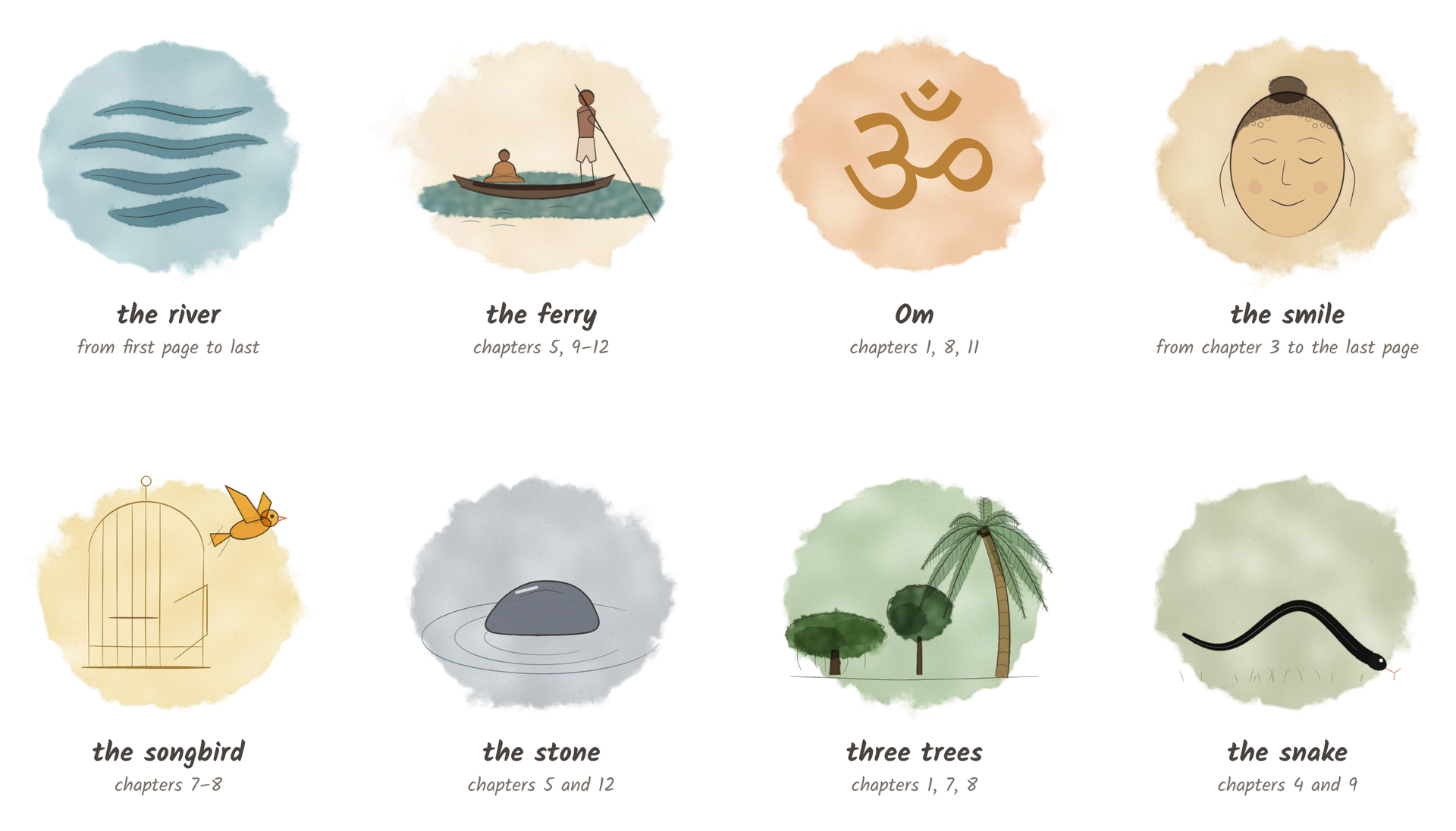
Figure 5. Eight recurring images and the chapters where they matter most. The sections below take them one by one.
The river
The river is there in the first sentence, where the boy plays by the boats. It is a crossing in Chapter 5, a grave in Chapter 8 and a teacher from Chapter 9 on. It stands for time, which flows yet is always present; for life, which changes yet stays the same water; and for unity, since all its voices make one song.
It also divides the book’s world. On one bank lie the forests of the Samanas and the Buddha’s grove, the life of the spirit. On the other lies Kamala’s city, the life of the senses. Siddhartha crosses from the first to the second, and in the end lives on neither bank but on the water between them.
The ferry
In Buddhist language the goal is the far shore, and the Buddha’s teaching is a raft for crossing to it. Hesse’s ferryman never settles on the far shore. He carries people back and forth for a lifetime, and his wisdom comes from the crossing itself. That is a quiet statement of the book’s view: peace does not lie beyond the world, but in moving through it with open eyes.
Om
Om opens the book as a meditation exercise, saves Siddhartha’s life in Chapter 8, and closes his search as the single word inside the river’s thousand voices. Each time it means more. It begins as a technique and ends as an experience.
The smile
The Buddha’s quiet smile is the first sign Siddhartha sees of real peace. Later the same smile grows on Vasudeva’s face, then on Siddhartha’s. In the last scene Govinda recognises in his friend’s smile exactly the smile of the Buddha. The smile is the book’s way of showing what cannot be said.
The songbird
Kamala keeps a rare songbird in a golden cage. When Siddhartha dreams it has died, he knows something in him is dying too: the voice that once guided him, kept beautifully and starved of air. Kamala’s answer is to set the real bird free. Later, at the river, Siddhartha realises that the bird in his own chest has not died after all.
Water and stone
In Chapter 5 Siddhartha says he moves toward his goals like a stone thrown into water, sinking straight to the bottom. It is the confident image of a young man. In Chapter 12 an old man holds a real stone in his hand and loves it for being exactly what it is. Between the two lies the whole book.
Trees
Siddhartha meditates under a banyan in Chapter 1, sits under a mango tree when he decides to leave the city, and almost drowns beside a coconut palm. Each tree echoes the most famous tree in Buddhism, the one under which the Buddha sat until he awoke. Siddhartha himself recalls that tree in Chapter 5, when he thinks of the Buddha obeying an inner voice.
Snakes, mirrors and clothes
Snakes mark shocks and endings: the shed skin of Chapter 4, and the small black snake that kills Kamala. Reflections mark self-knowledge: the aging face in the mirror in Chapter 7, the face he spits at in Chapter 8, and the face that turns out to be his father’s in Chapter 11. Clothes and hair change with each stage of life, from the Samana’s dust to the merchant’s perfume to the ferryman’s loincloth.
Two kisses
Part Two opens its real story with a kiss, when Kamala rewards Siddhartha’s poem and begins teaching him love. It ends with another, when Govinda kisses Siddhartha’s forehead and sees the unity of all things. The first kiss teaches the senses. The second reveals what lies beyond them.
Style and Structure
Hesse called the book an “Indian poem”, and he wrote it like one: plain words, long rhythmic sentences and patterns of three. The structure is just as deliberate, with two unequal parts, twelve chapters, and an ending that returns to the beginning.
Prose like scripture
The vocabulary is simple, the descriptions are sparse and very little happens. What carries the book is rhythm. The first sentence piles up places, the shade of the house, the sunny riverbank, the boats, the forest, the fig tree, like a chant.
Patterns of three are everywhere: “I can think. I can wait. I can fast.” Siddhartha’s life itself falls into three stages, with the Samanas, among the childlike people, and by the river.
Readers have long compared the style to old translations of Indian scriptures, and in English to the King James Bible. Its measured repetitions recall the Buddha’s discourses as they read in translation. The dialogue is formal, almost ceremonial, more like sacred conversation than modern talk.
The narrator stays close to Siddhartha’s mind. When he looks down on the childlike people, the prose shares his gentle irony. When he finally hears the river, the prose itself becomes a chant. Hesse’s biographer Ralph Freedman called books like this “lyrical novels”, held together by images and moods more than by plot.
On reading aloud. The river chapters are best read aloud, slowly. Much of their meaning lives in the rhythm, and translations differ in how much of that rhythm they keep.
Two parts, one circle
Part One has four chapters and Part Two has eight. The imbalance reflects the long pause in the writing, but readers have found patterns in it too.
One critic, Donald McCrory, noticed that four chapters plus eight could mirror the Buddha’s Four Noble Truths and Eightfold Path. He also traced in the plot three of the traditional stages of a Hindu man’s life: student, householder and forest-dweller. These are readings, not Hesse’s stated plan, but they fit.
The clearest shape is a circle. The book opens with Siddhartha and Govinda together and closes with them together again, roles reversed: the follower who once walked behind his friend now bows before him. The ferryman’s first words, that everything comes back, turn out to describe the novel itself. Even Kamala’s pleasure garden returns, filled with monks.
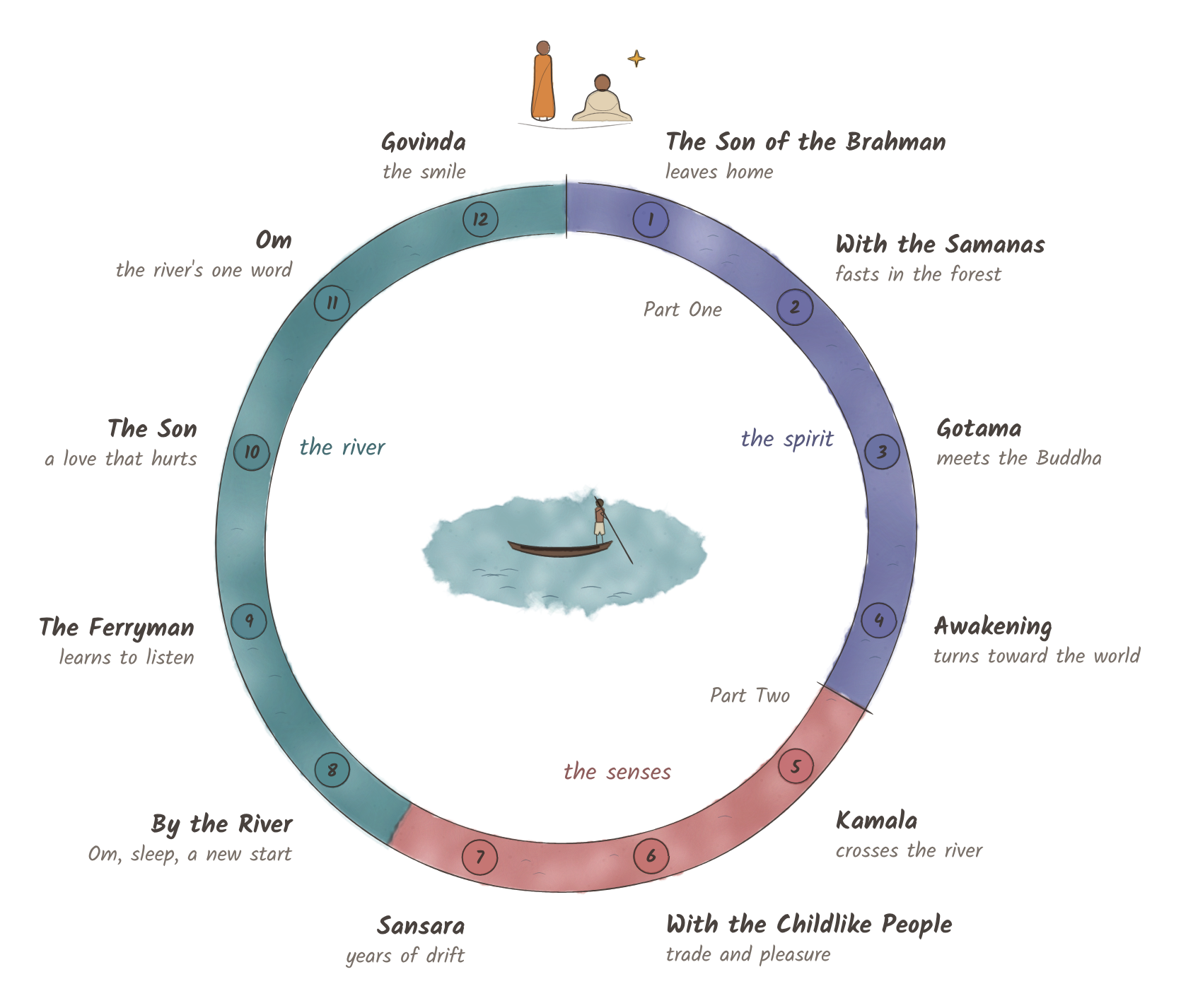
Figure 6. Twelve chapters on one circle. Part One has four chapters and Part Two has eight. The colours match the map in Figure 2: the spirit, the senses and the river. At the top, where the circle closes, Govinda bows before his old friend.
Time speeds up
Part One covers a few years in close detail. Part Two covers decades, sometimes in a single sentence: the years passed, and no one counted them. The slowing of events and the speeding of time both prepare the reader for the book’s claim that time is not real.
Siddhartha and the Buddha
The novel follows the Buddha’s life closely, argues with his teaching, and ends with its hero wearing the Buddha’s smile. It is less a Buddhist novel than a novel in conversation with Buddhism.
Parallel lives
Stage | The historical Buddha | Hesse's Siddhartha |
Birth | A prince of the Shakya clan, from the warrior class | The son of a Brahmin priest |
Name | Siddhartha Gautama | Siddhartha |
Leaving home | Leaves his palace, his wife and his newborn son | Leaves his father's house against his father's will |
Self-denial | Years of harsh asceticism, then rejects it | Three years with the Samanas, then rejects them |
Teachers | Outgrows his teachers and finds his own way | Leaves the Samanas, then the Buddha himself |
The tree | Awakens under a tree at Bodh Gaya | Wakes renewed under a coconut palm by the river |
A son | Rahula, a name tradition explains as "fetter" | A son who becomes his deepest bond and his deepest wound |
A courtesan | Ambapali gives her mango grove to his order | Kamala gives her garden to the Buddha's monks |
The end | Teaches for decades and dies at Kushinagar | Becomes a quiet ferryman and teaches with a kiss and a smile |
Where they part
Siddhartha never doubts that the Buddha reached awakening. He doubts that anyone else can reach it by being taught.
The rest follows from that. The Buddha left the world of desire behind at the start; Siddhartha goes deep into it and comes out the other side. The Buddha taught release from craving; Siddhartha ends by loving the world as it is, and Govinda is right that this sounds different. The Buddha taught that there is no permanent self; Siddhartha searches for one, in the language of the Upanishads, from his first page to his last.
Hesse’s turn from Buddhism
In a 1921 letter Hesse wrote that he had believed in Buddhist doctrine for years, but was no longer a Buddhist. He now found it beautiful and admirably disciplined, yet too rational and one-sided, and felt drawn instead to the India of gods and temples.
The German theologian Karl-Josef Kuschel, in a 2018 study of Hesse and Buddhism, calls the novel a Buddha poem written to set its author free from Buddhism. Scholars who teach Asian religions add a practical warning: Siddhartha is a fine guide to Hesse, and a misleading guide to Indian Buddhism.
A Buddhist spirit
Siddhartha’s objections echo things the Buddha himself said. The early discourses call speculative opinions “a thicket of views” and compare the teaching to a raft, made for crossing over and not for clinging to. They also describe the truth the Buddha found as beyond the reach of mere reasoning. A Buddhist reader can see in Siddhartha’s refusal to be taught a very Buddhist kind of refusal.
The ending comes closest of all to Zen. Chinese Chan Buddhists told how the Buddha once held up a flower without a word, and only his disciple Mahakasyapa understood and smiled: 拈花微笑, “picking up a flower, a faint smile”. Wisdom passed without words. Hesse’s novel ends the same way, with an old monk who could not understand a single sentence understanding everything in a kiss and a smile.
The link to Zen was close to home. Hesse’s cousin Wilhelm Gundert, to whom Part Two is dedicated, later translated the great Zen classic The Blue Cliff Record into German, and Hesse wrote poems inspired by it.
Difficult Passages
Most confusion about Siddhartha comes from a handful of passages. Here they are, each with the short answer first.
Leaving the Buddha
No one can hand over the Buddha’s experience, so Siddhartha has to leave him. In Chapter 3 he does not call the teaching wrong. He says, in effect: you found this yourself, so I must find it myself. He also fears that as a disciple his ego would not disappear but hide, behind the teaching, his love for the teacher and his place among the monks.
“Childlike people”
The phrase means ordinary people, and it is half scorn and half envy. The Kindermenschen live by desire and feeling without stepping back to watch themselves. In Chapter 6 Siddhartha looks down on them. By Chapter 11 he admires their power to love and suffer, and suspects that his own idea of oneness may be just another childish notion of thinkers. The phrase changes meaning as he changes.
The years of pleasure
The years of pleasure were a necessary detour. Hesse is not saying pleasure is good or bad. Siddhartha’s pride had hidden inside his holiness, and only by losing himself in the world could that proud self die. When he says he had to sin in order to live again, he is describing his own path, not giving advice. Vasudeva’s point in Chapter 10 is the same: nobody can be spared their own way.
“Time is not real”
The line means that every stage of a life exists at once. This is not a statement about physics. A river is present at its source and its mouth at the same moment, and in the same way a life’s childhood and old age belong to one whole. Seen like this, regret and fear lose their grip, and the future Buddha can be honoured in the sinner today rather than someday.
“The opposite of every truth”
The line is about the limits of words. Language cuts the world into halves: Sansara and Nirvana, good and evil, sinner and saint. The world itself is not cut. Any sentence therefore catches only one side, and its opposite catches the other. Siddhartha is not saying that anything goes. He is saying that no formula holds life whole.
Loving a stone
Siddhartha loves the stone for what it already is. Once he would have valued a stone because, in the cycle of rebirth, it might one day become a plant or a person. Now he loves it because it is already everything, stone and animal and god and Buddha, and also simply a stone, with its own colour, weight and sound. It is the book’s most concrete picture of oneness.
Teaching the unteachable
A book about wisdom that cannot be taught does not contradict itself. If wisdom cannot be taught, why write a novel? Because Hesse does not offer a doctrine. He offers a story to live through, much as Siddhartha offers Govinda a kiss instead of a sermon. Siddhartha even admits that words always distort a little, and adds that he likes this too.
Vasudeva’s departure
Vasudeva’s walk into the forest is left open on purpose. “Into the forests, into the oneness” can be read as death, as the last stage of an Indian holy man’s life, or as a teacher leaving because his work is done. Hesse lets the image hold all three.
Govinda’s vision
The vision is Siddhartha’s last teaching. The stream of faces in the last chapter is the river vision of Chapter 11, handed on without a word. Birth and death, violence and love, animals and gods flow into one another, and the smile over all of them is the smile of oneness, the same smile Govinda once saw on the Buddha.
The son who never returns
The son’s absence is the point. Many readers wait for the boy to come back. He does not. Love that tries to hold on has to learn to let go, and the son has his own Sansara to live. The novel refuses the happy reunion.
Reception
The book began as a modest success in Germany, found early readers in Asia, became a cult classic in 1960s America, and is now one of the most widely read German novels anywhere. Hesse’s books together have sold well over 100 million copies.
A late boom in Germany
S. Fischer published the novel in Berlin in 1922, when Hesse was already known for Demian. His reputation in Germany sank in the 1950s, and sales of his books hit a low in 1955. The revival came from abroad: after the American boom, more than 800,000 copies of his books sold in the German-speaking world in 1972 and 1973 alone.
Early readers in Asia
A Japanese translation appeared as early as 1925, and Hesse later said his Japanese readers understood him best. Translations into Indian languages followed from the 1950s. The Goethe-Institut in India calls it the German novel that has most shaped the image of India ever since, and a Hermann Hesse Society of India has published it in Sanskrit, Malayalam and Hindi.
The first Chinese translation appeared in 1968. Xu Jinfu’s (徐进夫) version, titled 流浪者之歌, “Songs of the Wanderers”, filled the margins with Buddhist notes and read Siddhartha’s farewell to the Buddha as a Zen master’s provocation. The translator Li Xuetao (李雪涛) has called that an overinterpretation, pointing out that Hesse knew little of Zen texts when he wrote the book.
In mainland China the book has a large new audience. A 2017 translation made directly from the German restored the subtitle 一首印度的诗, “An Indian Poem”, which earlier Chinese editions had dropped. On Douban more than 220,000 readers have marked that edition as read, with an average rating of 9.1. Li Xuetao’s own translation, also subtitled “An Indian Poem”, followed in 2022.
Chinese readers sometimes find their own echoes in it. Li Xuetao notes that Siddhartha’s image of most people as leaves blown by the wind recalls a line by the Song-dynasty monk-poet Daoqian (参寥子): “禅心已作沾泥絮,肯逐春风上下狂”, a mind of meditation that, like willow down stuck to the mud, no longer dances in the spring wind.
A cult book in America
The first English translation, by Hilda Rosner, came out from New Directions in 1951. Henry Miller and the Beat writers championed it through the 1950s. In the mid-1960s Hesse suddenly became a bestseller in the United States, helped by the enthusiasm of counterculture figures such as Timothy Leary and Colin Wilson. Asked in 1968 why he admired Hesse, one Harvard graduate answered that Hesse was “the first hippie”.
Because the 1922 original entered the public domain in the United States, a wave of new English translations followed from the late 1990s: Sherab Chödzin Kohn for Shambhala, Joachim Neugroschel for Penguin with an introduction by Ralph Freedman, Stanley Appelbaum for Dover, and Susan Bernofsky for the Modern Library. Free volunteer translations sit on Project Gutenberg.
Film, music and dance
- Film. Conrad Rooks’s Siddhartha (1972) starred Shashi Kapoor and Simi Garewal, was shot by Ingmar Bergman’s cameraman Sven Nykvist in Rishikesh and the palaces of Bharatpur, and premiered at the Venice Film Festival. A brief nude scene caused a controversy in India, where the film was released with cuts. A year earlier, the rock musical Western Zachariah (1971) had borrowed loosely from the novel.
- Music. The Canadian composer Claude Vivier wrote an orchestral Siddhartha (1976), and Pete Townshend of The Who wrote the song “The Ferryman” the same year. In 2024 Rachel Fuller reworked the novel as The Seeker, with Townshend as the ferryman.
- Dance. Taiwan’s Cloud Gate Dance Theatre premiered Lin Hwai-min’s Songs of the Wanderers (流浪者之歌) in 1994, inspired by the novel and by Lin’s pilgrimage to Bodh Gaya. Three and a half tonnes of golden rice pour onto the stage as a river, and the piece ends with one dancer raking the rice into concentric circles.
The critics’ case
- It is not a reliable guide to India or to Buddhism. Hesse never saw India and called the book European. Teachers of Asian religion warn students not to take it as an introduction to Buddhism.
- Its East is a Western dream. Since Edward Said’s Orientalism (1978), readers have been alert to Western books that use an imagined East as a stage for Western inner drama. Siddhartha fits that description in many ways.
- Its women serve the hero. Kamala is the strongest woman in the book, yet she exists mainly for Siddhartha’s growth. A widely shared Douban review argues that the novel’s quest for the “human” self quietly leaves women outside the gate.
- Its hero can be insufferable. Young Siddhartha’s contempt for ordinary people reads as arrogance. The novel answers by making him outgrow it, and readers disagree about whether that answer convinces.
Why it lasts
It is short, simple and open. It offers a path rather than a creed, and every reader brings a different crisis to it. The Goethe-Institut essayist Martin Kämpchen notes, with some irony, that the hippies carried it like a bible while ignoring the discipline and sacrifice it asks of its hero. Both the use and the irony are part of the book’s life.
Open Questions
These questions have no single right answer. They work for a quiet evening alone or for a reading group, and most of them get better after a second reading.
- Siddhartha leaves his father, and decades later his son leaves him. Is the second departure a punishment, a mirror, or a gift?
- In Chapter 3 Siddhartha finds a “gap” in the Buddha’s teaching. Is that a real flaw, or a young man’s cleverness? Does the rest of his life answer his own objection?
- “I can think. I can wait. I can fast.” Which of the three matters most today, and which is the easiest to lose?
- Kamala tells Siddhartha he cannot love. What has to happen between Chapter 6 and Chapter 10 before he can?
- Govinda follows a great teacher faithfully all his life and still finds no peace. Is he a failure? What would the book say to a reader who recognises herself in Govinda?
- The wisest person in the novel is a ferryman who barely speaks. Why might Hesse have made wisdom almost wordless?
- Siddhartha says he had to sin in order to live again. Is that insight, or a comforting story told afterwards?
- “The opposite of every truth is also true.” What happens to a firmly held belief when its opposite is stated as honestly as possible?
- The river teaches that the boy and the old man are separated only by a shadow. Where in an ordinary life do the child and the adult still meet?
- Does the novel treat Kamala fairly? How would her story read if she told it?
- Hesse needed eighteen months and a breakdown to find the ending. Does that history make Part Two more convincing, or less?
- Siddhartha’s years as a merchant are full of restless effort, gambling and self-exploitation. How do those chapters look beside a modern critique of achievement culture, such as Byung-Chul Han’s The Burnout Society?
- If wisdom cannot be taught, what is a book like this one for?
Timeline
Hesse’s life, the making of the book, and its life afterwards, in order.
Year | What happened |
1842 | Hesse's mother, Marie Gundert, is born at a mission in South India |
1877 | 2 July: Hermann Hesse is born in Calw, in the Black Forest |
1891–92 | Enters the Maulbronn seminary, runs away and attempts suicide |
1895 | Begins a bookseller's apprenticeship in Tübingen |
1904 | Peter Camenzind makes his name; marries Maria Bernoulli; moves to Gaienhofen |
1911 | Sails to Ceylon, Malaya, Singapore and Sumatra; never reaches India |
1914 | First World War; his essay "O Friends, Not These Tones" appears on 3 November |
1916 | His father dies; breakdown; therapy with J. B. Lang; he begins to paint |
1918 | The war ends; Spengler's The Decline of the West, volume 1 |
1919 | Demian appears under a false name; Hesse moves alone to Montagnola in May and begins Siddhartha in December |
1920 | Part One finished by summer; the writing stalls |
1921 | Analysis with C. G. Jung in May and June; Part One printed on its own in July |
1922 | February: writes that the book will end in the Tao; March to May: Part Two; October: Siddhartha is published. Eliot's The Waste Land appears the same autumn |
1923 | Becomes a Swiss citizen |
1925 | First Japanese translation |
1927 | Steppenwolf |
1931 | Essay "My Belief" names Siddhartha as his confession of faith; marries Ninon Dolbin |
1932 | Essay "A Bit of Theology" sets out his three stages of becoming human; Journey to the East |
1943 | The Glass Bead Game |
1946 | Nobel Prize in Literature |
1951 | First English translation, by Hilda Rosner (New Directions) |
1962 | 9 August: Hesse dies in Montagnola, aged 85 |
Mid-1960s | Hesse becomes a bestseller in the United States |
1968 | First Chinese translation |
1972 | Conrad Rooks's film premieres at Venice |
1994 | Cloud Gate Dance Theatre premieres Songs of the Wanderers |
2017 | A new Chinese translation from the German restores the subtitle "An Indian Poem" |
2022 | The novel turns 100; Li Xuetao's Chinese translation appears |
Glossary
Chinese editions render names and titles in different ways. The tables give the most common forms, with the choices of Li Xuetao’s 2022 translation noted where they differ.
Names
English | German | Chinese renderings |
Siddhartha | Siddhartha | 悉达多 (some older editions: 席特哈尔塔) |
Govinda | Govinda | 戈文达, 乔文达; Li Xuetao: 劬嫔陀 |
Gotama (the Buddha) | Gotama | 乔达摩 |
Kamala | Kamala | 卡玛拉; Li Xuetao: 伽摩罗 |
Kamaswami | Kamaswami | 卡马斯瓦密, 卡玛斯瓦密 |
Vasudeva | Vasudeva | 瓦苏代瓦, 瓦稣迪瓦; Li Xuetao: 婆薮提婆 |
Anathapindika | Anathapindika | 给孤独长者 |
Chapter titles
The Chinese column gives a plain rendering of the German; editions word these differently.
| No. | English | German | Chinese |
| 1 | The Son of the Brahman | Der Sohn des Brahmanen | 婆罗门之子 |
| 2 | With the Samanas | Bei den Samanas | 在沙门中间 |
| 3 | Gotama | Gotama | 乔达摩 |
| 4 | Awakening | Erwachen | 觉醒 |
| 5 | Kamala | Kamala | 卡玛拉 |
| 6 | With the Childlike People | Bei den Kindermenschen | 在孩子般的世人中间 (Li Xuetao: 跟儿童心智的人在一起) |
| 7 | Sansara | Sansara | 轮回 |
| 8 | By the River | Am Flusse | 在河边 |
| 9 | The Ferryman | Der Fährmann | 船夫 (Li Xuetao: 摆渡人) |
| 10 | The Son | Der Sohn | 儿子 |
| 11 | Om | Om | 唵 |
| 12 | Govinda | Govinda | 戈文达 (Li Xuetao: 劬嫔陀) |
Terms
| Term | What it means | Chinese | Chinese |
| Agni | Hindu god of fire, glimpsed in Govinda’s vision | 阿耆尼 | 婆罗门之子 |
| Atman | The true, inner self | 阿特曼, 真我 | 在沙门中间 |
| Bhagavad Gita | Hindu poem in which Krishna teaches the warrior Arjuna | 《薄伽梵歌》 | 乔达摩 |
| Brahma | The creator god | 梵天 | 觉醒 |
| Brahman | The one reality behind all things | 梵 | 卡玛拉 |
| Brahmin | Member of the priestly class | 婆罗门 | 在孩子般的世人中间 (Li Xuetao: 跟儿童心智的人在一起) |
| Buddha | “The awakened one”, title of Siddhartha Gautama | 佛陀 | 轮回 |
| Childlike people (Kindermenschen) | Ordinary people who live by desire and feeling | 孩子般的世人 | 在河边 |
| Eightfold Path | Right view, intention, speech, action, livelihood, effort, mindfulness and concentration | 八正道 | 船夫 (Li Xuetao: 摆渡人) |
| Four Noble Truths | Suffering, its cause, its end, and the path to its end | 四圣谛 | 儿子 |
| Jetavana | The grove near Savathi where the Buddha often stayed | 祇园 (祇树给孤独园) | 唵 |
| Krishna | Hindu god, the divine teacher of the Gita | 黑天, 克里希那 | 戈文达 (Li Xuetao: 劬嫔陀) |
| Mara | The tempter of Buddhist legend; in Chapter 4 the world is no longer “a spell of Mara” | 魔罗 | |
| Maya | Illusion, the veil of appearances | 摩耶, 幻 | |
| Middle Way | The Buddha’s path between indulgence and self-torment | 中道 | |
| Nirvana | The “blowing out” of craving; liberation | 涅槃 | |
| Om | The sacred syllable | 唵 | |
| Pali | Language of the early Buddhist scriptures, source of spellings such as Gotama and Samana | 巴利语 | |
| Prajapati | Creator god of the Vedas, doubted by Siddhartha in Chapter 1 | 生主 | |
| Sakyamuni | “Sage of the Shakyas”, a title of the Buddha | 释迦牟尼 | |
| Samana | Wandering ascetic (Sanskrit śramaṇa) | 沙门 | |
| Samsara (Sansara) | The wheel of birth, death and rebirth; the endless round of craving | 轮回 | |
| Savathi | Savatthi or Shravasti, capital of Kosala | 舍卫城 | |
| Tao | “The Way”, the natural flow of things in Laozi’s Tao Te Ching | 道 | |
| Upanishads | Philosophical texts that follow the Vedas | 奥义书 | |
| Vedas | The oldest Hindu scriptures | 吠陀 | |
| Wu wei | Acting without forcing | 无为 | |
| 2022 | The novel turns 100; Li Xuetao’s Chinese translation appears |